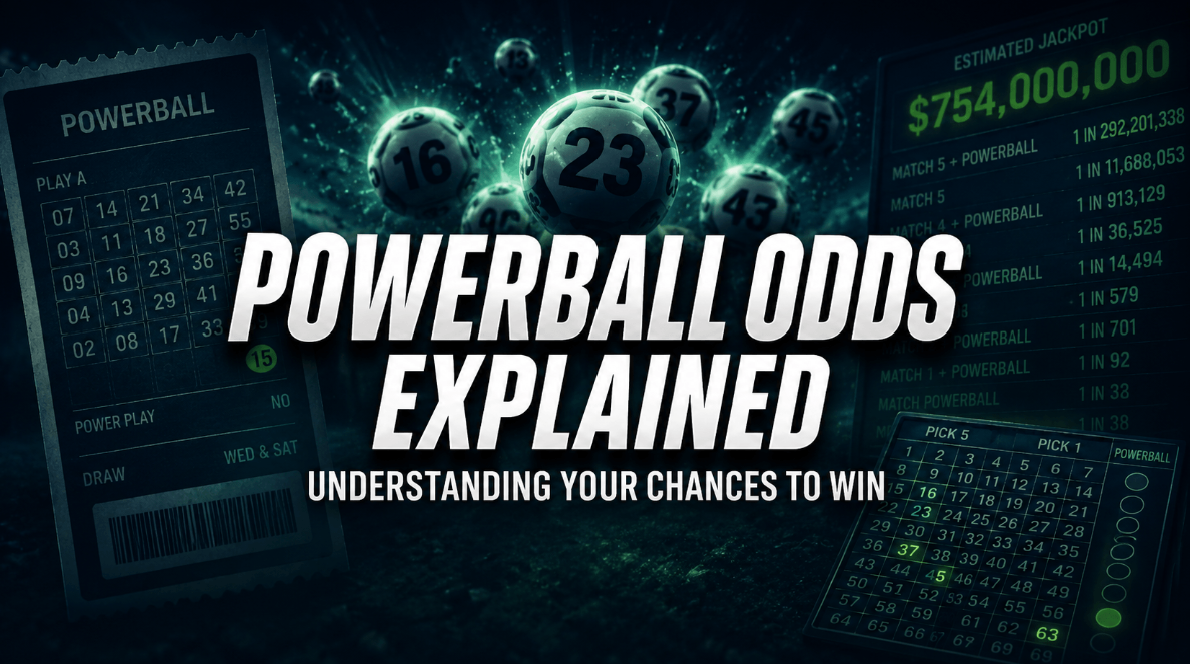
Powerball is one of the most widely recognised lottery games in the world, known primarily for its multi-hundred-million-dollar jackpots and its odds of 1 in 292,201,338 for the top prize. Understanding how those odds are calculated, how the nine prize tiers are triggered, how Power Play multipliers affect non-jackpot prizes, and how the jackpot is structured between lump sum and annuity options gives players a complete picture of what any Powerball ticket actually offers.
This article covers the mechanics of the Powerball draw, the full prize tier structure with odds, the step-by-step jackpot odds calculation, jackpot growth and payout structure, and a direct comparison with Mega Millions.
What Is Powerball?
Powerball is a multi-jurisdictional lottery game operated by the Multi-State Lottery Association (MUSL), a non-profit organisation established by agreement among US state lottery operators. As of 2025, Powerball is available in 45 US states, the District of Columbia, Puerto Rico, and the US Virgin Islands.
Powerball draws take place three times per week — on Monday, Wednesday, and Saturday evenings. A single Powerball ticket costs $2.00 USD. Players may add the Power Play option for an additional $1.00 per play, which multiplies non-jackpot prizes by a randomly selected multiplier.
Players outside the United States can access Powerball through licensed international lottery platforms. Players researching mobile access options — including the 1xbet mob aze — can explore lottery products available through licensed platforms in their region.
Powerball has produced some of the largest lottery jackpots in history. The record jackpot — $2.04 billion — was awarded in November 2022, making it the largest lottery prize ever recorded globally.
How Powerball Works: The Draw Mechanic
How the Main Ball Pool Works (1–69)
In each Powerball draw, five white balls are drawn from a pool of 69 numbered balls (1 through 69). The five balls are drawn without replacement — meaning once a ball is drawn, it cannot be drawn again in the same draw. The order in which the five white balls are drawn does not matter. A ticket matches the main pool when its five selected numbers match all five drawn white balls in any order.
How the Powerball Pool Works (1–26)
Separately, one red Powerball is drawn from a second, independent pool of 26 balls (numbered 1 through 26). The Powerball is drawn completely independently of the white ball draw — the two pools do not interact. A ticket must match the Powerball number exactly for prize tiers that require a Powerball match.
How Draw Frequency and Ticket Sales Affect the Jackpot
Because draws occur three times per week, the jackpot accumulates contribution from a higher volume of ticket sales per week than twice-weekly games. Every ticket sold contributes a portion of its price to the prize fund. When no ticket matches all five white balls plus the Powerball in a given draw, the jackpot rolls over — increasing by the amount contributed from that draw's ticket sales. Consecutive rollovers drive the largest jackpots, which in turn increase ticket sales as the jackpot grows.
How Powerball Prize Tiers Are Structured
The Nine Prize Tiers: From Jackpot to Minimum Win
Powerball awards prizes across nine distinct tiers. Each tier is determined by how many of the five white balls a ticket matches, and whether the ticket matches the Powerball. The jackpot — Tier 1 — requires matching all five white balls plus the Powerball. The minimum prize — Tier 9 — requires matching the Powerball alone, with no white ball matches.
The nine tiers, from highest to lowest:
- Match 5 white balls + Powerball → Jackpot
- Match 5 white balls, no Powerball → $1,000,000
- Match 4 white balls + Powerball → $50,000
- Match 4 white balls, no Powerball → $100
- Match 3 white balls + Powerball → $100
- Match 3 white balls, no Powerball → $7
- Match 2 white balls + Powerball → $7
- Match 1 white ball + Powerball → $4
- Match Powerball only (0 white balls) → $4
How Each Tier Is Triggered by Ball Match Combinations
Each prize tier is triggered by a specific combination of white ball matches and Powerball match status. Matching more white balls without the Powerball may produce a lower prize than matching fewer white balls with the Powerball — for example, matching 4 white balls without the Powerball pays $100, while matching 3 white balls with the Powerball also pays $100. The presence or absence of the Powerball match is a binary variable that either activates or deactivates the Powerball contribution to each tier.
The Power Play Multiplier: How It Affects Non-Jackpot Prizes
Power Play is an optional add-on purchased at the time of ticket buying for $1.00 extra per play. When Power Play is active on a ticket, all non-jackpot prizes are multiplied by the Power Play number drawn on the night of the draw. The jackpot itself is never multiplied by Power Play. The second prize of $1,000,000 is a special case — it doubles to $2,000,000 when Power Play is purchased, regardless of which Power Play multiplier is drawn.
How Powerball Odds Are Calculated
The Combination Formula: How Ball Pool Sizes Determine Odds
The odds for each prize tier are calculated using the combination formula, written mathematically as C(n, k) — read as "n choose k" — which counts the number of ways to choose k items from a pool of n items when order does not matter.
The formula is:
C(n, k) = n! ÷ (k! × (n − k)!)
Where:
- n = total number of items in the pool
- k = number of items selected
- ! denotes factorial (e.g., 5! = 5 × 4 × 3 × 2 × 1 = 120)
For the white ball pool: n = 69, k = 5 For the Powerball pool: n = 26, k = 1 (exactly one Powerball is drawn)
Step-by-Step Jackpot Odds Calculation (1 in 292,201,338)
How the jackpot odds of 1 in 292,201,338 are derived:
- Calculate the number of ways to choose 5 white balls from 69: C(69, 5) = 69! ÷ (5! × 64!) = (69 × 68 × 67 × 66 × 65) ÷ (5 × 4 × 3 × 2 × 1) = 1,348,621,560 ÷ 120 = 11,238,513
- Calculate the number of ways to choose 1 Powerball from 26: C(26, 1) = 26 ÷ 1 = 26
- Multiply the two results to get the total number of possible ticket combinations: 11,238,513 × 26 = 292,201,338
- There is exactly one winning jackpot combination per draw: Odds of winning the jackpot = 1 in 292,201,338
Each Powerball ticket purchased has exactly 1 in 292,201,338 odds of winning the jackpot, regardless of which numbers are chosen, what numbers were drawn previously, or how large the jackpot is. Draws are statistically independent events.
How Lower Tier Odds Are Derived from the Same Formula
Lower tier odds are calculated by the same combination formula, modified to count the number of ways a partial match can occur.
For example, for Tier 3 (match 4 white balls + Powerball):
- Ways to choose exactly 4 matching balls from the 5 drawn: C(5, 4) = 5
- Ways to choose 1 non-matching ball from the remaining 64 non-drawn balls: C(64, 1) = 64
- Combined white ball combinations for this tier: 5 × 64 = 320
- Powerball must match: 1 in 26
- Total combinations for this outcome: 320 × 1 = 320
- Odds: 292,201,338 ÷ 320 = approximately 1 in 913,129
Full Powerball Odds and Prize Tier Table
|
Prize Tier
|
Match Requirement
|
Odds of Winning
|
Fixed Prize / Jackpot
|
Power Play Eligible
|
Power Play Prize (5x example)
|
|
1
|
5 white + Powerball
|
1 in 292,201,338
|
Jackpot (starts $20M+)
|
No
|
Jackpot unchanged
|
|
2
|
5 white, no Powerball
|
1 in 11,688,054
|
$1,000,000
|
Yes (doubles to $2M)
|
$2,000,000 fixed
|
|
3
|
4 white + Powerball
|
1 in 913,129
|
$50,000
|
Yes
|
$250,000
|
|
4
|
4 white, no Powerball
|
1 in 36,525
|
$100
|
Yes
|
$500
|
|
5
|
3 white + Powerball
|
1 in 14,494
|
$100
|
Yes
|
$500
|
|
6
|
3 white, no Powerball
|
1 in 580
|
$7
|
Yes
|
$35
|
|
7
|
2 white + Powerball
|
1 in 701
|
$7
|
Yes
|
$35
|
|
8
|
1 white + Powerball
|
1 in 92
|
$4
|
Yes
|
$20
|
|
9
|
Powerball only
|
1 in 38
|
$4
|
Yes
|
$20
|
Overall odds of winning any prize: approximately 1 in 24.9
How the Powerball Jackpot Is Structured
How the Jackpot Starts and Grows Between Draws
The Powerball jackpot starts at a minimum advertised amount — currently $20 million — following each jackpot win. Between wins, the jackpot grows with each draw by the amount contributed from ticket sales in that draw period. Because no cap exists on jackpot size, consecutive rollovers can accumulate into prizes of several hundred million dollars over weeks or months without a jackpot winner.
The advertised jackpot figure is always the annuity value — the total paid out over 30 years if the winner selects the annuity option. The cash value (lump sum) is a separate, lower figure published alongside the annuity amount.
Lump Sum vs. Annuity: How the Two Payout Options Work
Powerball jackpot winners choose between two payout structures at the time of claiming their prize:
How lump sum and annuity options differ:
- Lump sum (cash value): A single immediate payment representing the present value of the jackpot fund. The lump sum is typically 50–60% of the advertised annuity jackpot. For a $500 million advertised jackpot, the cash value is approximately $239–$255 million before taxes. The full amount is subject to tax in the year of receipt.
- Annuity payout: 30 graduated annual payments over 29 years (one immediate payment followed by 29 annual payments). Each payment is 5% larger than the previous one, designed to keep pace with inflation. The total of all 30 payments equals the full advertised jackpot. Each annual payment is taxed as income in the year it is received.
- Total value comparison: The annuity delivers the full advertised amount over time. The lump sum delivers less in nominal terms but more in present-value terms if invested — the theoretical equivalence depends on assumed investment return rates and personal tax situation.
- Flexibility: The lump sum provides immediate access to the full net amount. The annuity provides predictable annual income but no access to the total fund as a single resource.
How Federal and State Tax Reduces the Net Jackpot
Federal income tax applies to all Powerball winnings above $600. For jackpot-level winnings, the federal withholding rate at the time of payout is 24% (automatic withholding), with the marginal rate rising to 37% for income above the highest federal tax bracket threshold. Winners in the top bracket effectively pay 37% federal tax on jackpot proceeds.
State income tax applies in most US states, ranging from 0% (in states with no income tax, such as Florida and Texas) to approximately 10–11% in the highest-rate states. A $500 million advertised jackpot, taken as a lump sum at approximately $240 million, after 37% federal tax and 5% state tax leaves a net of approximately $139 million — less than 28% of the advertised headline figure.
Tax advice from a qualified tax professional is strongly recommended for any large lottery prize, as individual circumstances, state of residence, and tax law changes affect the net amount received.
Power Play: How the Multiplier Option Works
Available Power Play Multipliers (2x, 3x, 4x, 5x, 10x)
The Power Play multiplier is drawn separately from the main Powerball draw. Before each draw, one Power Play number is randomly selected from a pool of available multipliers: 2x, 3x, 4x, 5x, and — under certain conditions — 10x. The multiplier applies uniformly to all non-jackpot prize tiers on Power Play tickets for that draw.
How the 10x Multiplier Is Restricted to Lower Jackpot Sizes
The 10x Power Play multiplier is available only when the advertised jackpot is $150 million or below. When the jackpot exceeds $150 million, the 10x multiplier is removed from the multiplier pool, leaving 2x, 3x, 4x, and 5x as the available options. This restriction reduces the expected value of the Power Play option as jackpots grow larger.
How Power Play Affects the $1 Million Second Prize
The second prize — awarded for matching all five white balls without the Powerball — is a fixed $1,000,000. Power Play does not multiply this prize by the drawn multiplier. Instead, the second prize doubles to a fixed $2,000,000 whenever a Power Play ticket wins it, regardless of whether the drawn multiplier is 2x, 3x, 4x, 5x, or 10x. This is the only prize tier with a Power Play override rule rather than a standard multiplication.
Powerball vs. Mega Millions: Odds and Structure Comparison
|
Factor
|
Powerball
|
Mega Millions
|
|
Operator
|
Multi-State Lottery Association (MUSL)
|
Multi-State Lottery Association (MUSL)
|
|
Main ball pool
|
5 balls from 1–69
|
5 balls from 1–70
|
|
Bonus ball pool
|
1 Powerball from 1–26
|
1 Mega Ball from 1–25
|
|
Jackpot odds
|
1 in 292,201,338
|
1 in 302,575,350
|
|
Starting jackpot
|
$20 million
|
$20 million
|
|
Draw days
|
Monday, Wednesday, Saturday
|
Tuesday, Friday
|
|
Multiplier option
|
Power Play (+$1)
|
Megaplier (+$1)
|
|
Multiplier range
|
2x–10x (10x restricted above $150M jackpot)
|
2x–5x
|
|
Second prize
|
$1,000,000 ($2M with Power Play)
|
$1,000,000 ($3–5M with Megaplier)
|
|
Ticket price
|
$2.00
|
$2.00
|
Mega Millions carries marginally worse jackpot odds (1 in 302,575,350 vs. 1 in 292,201,338). Powerball draws three times per week against Mega Millions' twice-weekly schedule, producing more draw opportunities per week. Both lotteries operate under the same MUSL structure and apply equivalent federal tax treatment.
How Jackpot Rollovers Affect Ticket Sales and Prize Growth
A rollover occurs in any draw where no ticket matches all five white balls plus the Powerball. The unclaimed jackpot amount carries forward to the next draw, augmented by the fresh ticket sales from that draw period. Consecutive rollovers compound this effect, producing progressively larger jackpots.
Research on US lottery purchasing patterns consistently shows that ticket sales increase non-linearly as jackpots grow beyond certain psychological thresholds — $100 million, $300 million, $500 million. This "lottery fever" effect produces a positive feedback loop: a larger jackpot drives more ticket sales, which grows the jackpot faster, which drives further ticket sales.
Mathematically, more tickets sold does not improve any individual ticket's odds — each ticket independently holds 1 in 292,201,338 odds for the jackpot. However, a higher volume of tickets sold in a single draw increases the probability that at least one ticket will match the jackpot combination, which is why very large jackpots are more likely to be won in a single draw than smaller ones.
How Taxes Affect Powerball Winnings
Federal Tax Withholding on Jackpot Winnings
US federal tax applies to all lottery prizes. For prizes above $5,000, lottery operators are required to withhold 24% at the point of payment. However, jackpot-level prizes push winners into the highest federal income tax bracket — 37% marginal rate — meaning the effective federal tax obligation exceeds the 24% withheld. Winners are responsible for paying the difference when filing their annual tax return.
State Tax Variation Across US States
State income tax treatment of lottery prizes varies significantly. States with no personal income tax — including Florida, Texas, Washington, and others — apply no state tax on lottery winnings. Most other states apply standard income tax rates ranging from approximately 3% to 11%. Winners resident in New York City face combined city and state rates exceeding 13%.
How Non-US Winners Are Taxed
Non-US residents who win a Powerball prize face a mandatory 30% federal withholding rate on all US-source gambling winnings, compared to 24% for US residents. This rate may be modified by tax treaty agreements between the US and the winner's country of residence. Non-US winners should consult a tax professional familiar with international tax treaty provisions before claiming any prize, as treaty eligibility and the applicable withholding rate are country-specific.
Responsible gambling reminder: Lottery tickets are a form of entertainment. Each Powerball ticket carries fixed, independent odds of 1 in 292,201,338 for the jackpot. Past draws have no influence on future results. Set a fixed budget for lottery participation and treat it as entertainment expenditure rather than an investment.
Common Misconceptions About Powerball Odds
Most common misconceptions about Powerball odds and how lottery probability works:
- "Certain numbers are luckier than others" — All numbers in the white ball pool (1–69) and Powerball pool (1–26) have an identical probability of being drawn in each draw. No number is statistically "due" based on past results, and no number combination has higher jackpot odds than another.
- "Buying more tickets dramatically improves jackpot odds" — Buying 10 tickets improves the odds from 1 in 292,201,338 to 10 in 292,201,338 — still a statistically negligible probability. The improvement in absolute terms is linear but remains astronomically small relative to the jackpot odds.
- "Previous draws tell you what numbers to avoid or favour" — Powerball draws are statistically independent events. Each draw uses freshly randomised ball machines. A number drawn in the previous draw has identical probability of being drawn again in the next draw.
- "If the jackpot is huge, I have better odds" — The jackpot size has no effect on the odds of any individual ticket winning. The odds are fixed at 1 in 292,201,338 per ticket regardless of jackpot size.
- "The advertised jackpot is what winners receive" — The advertised figure is the annuity total. After choosing the lump sum option and applying federal and state taxes, the net amount received is typically 25–35% of the headline jackpot figure.
- "Joining a lottery syndicate gives better odds per dollar" — A syndicate pools multiple tickets, improving the group's aggregate odds. However, any prize won is divided equally among members. The expected value per dollar contributed to the syndicate is identical to buying a single ticket — the risk and reward are proportionally distributed.
FAQ
What are the exact odds of winning the Powerball jackpot? The odds of winning the Powerball jackpot are exactly 1 in 292,201,338 per ticket. This figure is calculated by multiplying the number of ways to choose 5 white balls from 69 — which is 11,238,513 — by the number of possible Powerballs, which is 26. The result is 292,201,338 total possible ticket combinations, of which exactly one matches the jackpot combination for any given draw.
What are the overall odds of winning any Powerball prize? The overall odds of winning any prize in Powerball — from the jackpot down to the $4 minimum prize for matching the Powerball alone — are approximately 1 in 24.9. Most winning tickets fall in the two lowest prize tiers (Tiers 8 and 9), which pay $4.
How does Power Play work and is it worth buying? Power Play multiplies all non-jackpot prizes by a randomly drawn multiplier (2x–10x). The second prize doubles to $2,000,000 regardless of which multiplier is drawn. Whether Power Play offers positive expected value depends on the jackpot size (the 10x multiplier is removed above $150 million) and the current multiplier pool composition. It costs $1 extra per play and increases the expected non-jackpot return.
What is the difference between the lump sum and annuity payout? The annuity pays the full advertised jackpot in 30 graduated annual payments (one immediate + 29 annual). Each payment increases by 5%. The lump sum is a single immediate payment at approximately 50–60% of the advertised total, representing the present cash value of the jackpot fund. Both options are subject to federal and state income tax. The lump sum is subject to tax immediately on the full received amount; annuity payments are taxed in the year each payment is received.
How much tax does a Powerball winner actually pay? US residents face 24% mandatory federal withholding at payment, with additional obligation up to the 37% marginal rate at tax filing. State tax adds 0–11%+ depending on the winner's state. Non-US residents face a 30% federal withholding rate, potentially modified by tax treaty. On a $500 million advertised jackpot taken as a lump sum of approximately $240 million, total federal and state tax can reduce the net amount to approximately $130–$150 million. Tax professionals with lottery expertise should be consulted for accurate individual calculations.
Can non-US residents play Powerball? Powerball tickets must be purchased within the United States — physically at an authorised retailer in a participating jurisdiction. However, international lottery courier services and some licensed online lottery platforms allow non-US residents to purchase US Powerball tickets on their behalf, for a service fee. Winnings are subject to the 30% non-resident federal withholding rate and potentially additional taxes in the winner's home country.
Does it matter which Powerball numbers I choose? No. Every combination of five white balls from 1–69 plus one Powerball from 1–26 has identical odds: 1 in 292,201,338 for the jackpot. Choosing "popular" numbers does not affect winning odds but does affect potential prize sharing — if popular number combinations win, more tickets may share the prize, reducing each winner's share. Choosing less frequently selected combinations does not improve odds of winning but may reduce prize-sharing risk if the jackpot is won.